Ricco gives each student a job, a monthly paycheck, and five bills, then asks the question a worksheet rarely does: now what? Keep the cash, save it, invest it, upgrade the apartment, or pay for a course that raises the salary. One connected financial life, played one month at a time, with no real money at risk.
Teaching financial literacy? See Ricco for Teachers
Many financial literacy games for students are collections of short activities: a budgeting mini-game here, an investing quiz there. Ricco is a browser-based financial literacy simulation for students built the other way around. Each student picks one of eight professions, from Artist at $2,500 a month to Doctor at $8,000, starts with one month's salary in cash, and takes over a character's finances: rent, food, utilities, transportation, and entertainment every month, plus whatever life sends in between.
Everything connects. The profession sets the paycheck. The paycheck funds a lifestyle, and each lifestyle choice moves two stats, health and happiness; let either stay critically low for too long and the game ends. Whatever survives the bills can sit as cash, earn interest in a savings account, lock into a 1-, 5-, or 10-year bond, ride an S&P 500-style index fund through bull and bear markets, or pay for a course that permanently raises the salary. A decision made in month 2 is still shaping month 20.
That is what makes Ricco a personal finance game for students rather than a set of disconnected activities. Students don't finish a budgeting level and then start an unrelated investing level. They carry one budget into their investing decisions, one portfolio into their next emergency, and one salary through every choice. The scoreboard is net worth: cash, savings, bonds, and index fund combined. Reaching $1,000,000 wins the game, but the learning happens in the months along the way, and progress saves automatically, so a game can continue across class periods or at home.
Every turn is one in-game month. This is the loop a student runs, starting from a real Month 1 as a Barista.
Eight jobs, each with its own monthly salary: Artist $2,500, Barista $2,800, Chef $3,200, Teacher $3,500, Nurse $4,500, Engineer $6,000, Software Developer $7,000, Doctor $8,000. Starting cash is one month's pay.
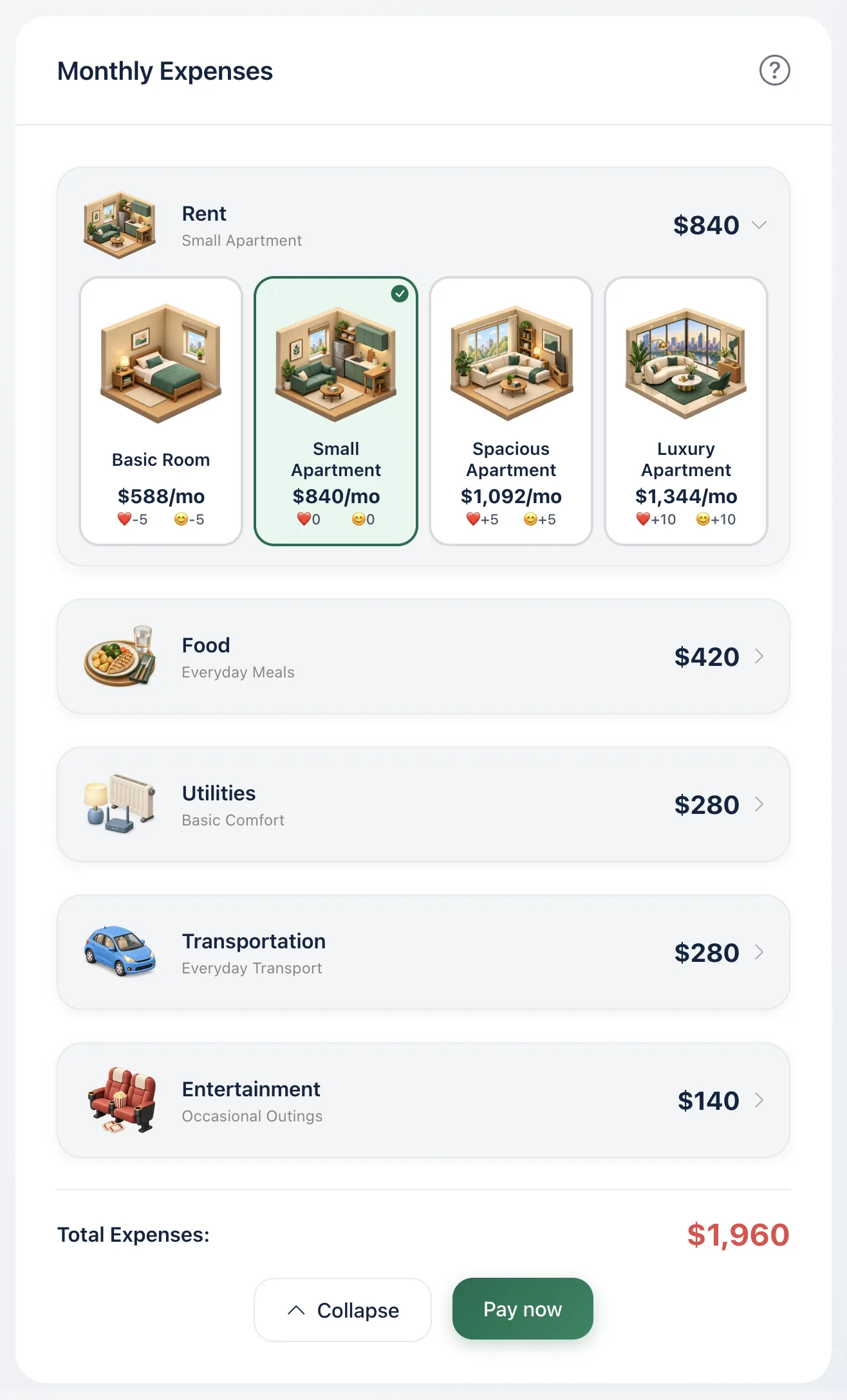
Rent, food, utilities, transportation, and entertainment each have four levels. A cheaper level frees cash but lowers health and happiness; a nicer one does the reverse. The price and the effect are visible before every choice.
Expenses must be paid before the month can move on. If cash is short, the only fix is to adjust the lifestyle; the game won't advance around an unpaid bill.
Deposit it in savings, buy a bond, buy index fund shares, enroll in a course, or hold cash for whatever comes next. Nothing forces the choice, and each option behaves differently over time.
Every few months an event lands: a repair bill or medical emergency that must be paid, an offer like concert tickets to accept or decline, or a windfall like a work bonus. Each one moves cash, health, or happiness.
The next paycheck arrives, interest and dividends land on their schedule, the market moves, and net worth updates. Achievements such as Rainy Day Fund and Year One Done mark milestones. Then the loop starts again from the situation last month created.
These are actual numbers from a Ricco playthrough, not marketing math.
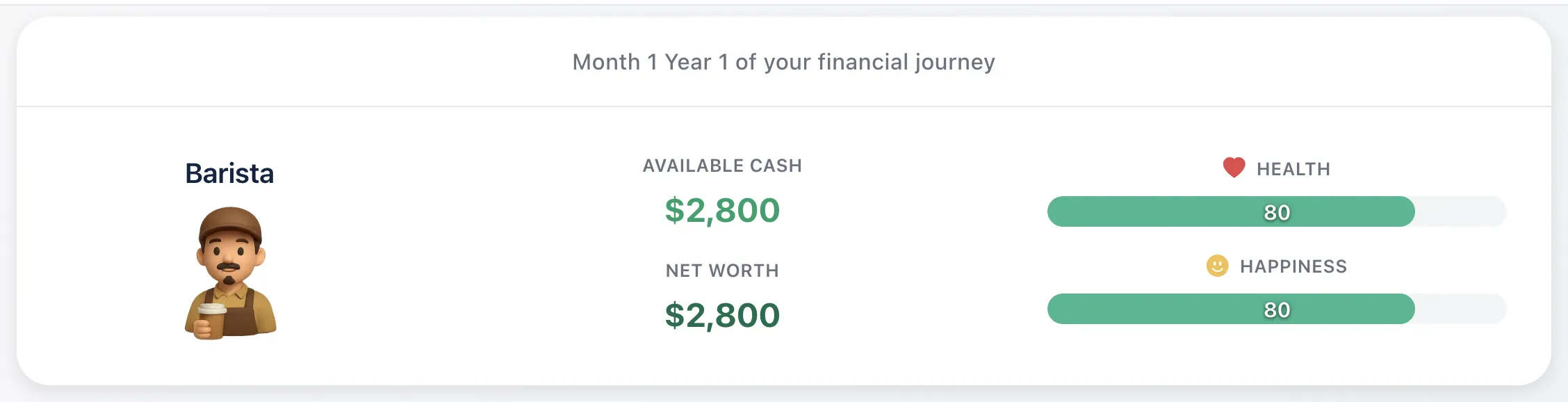
A student starts as a Barista earning $2,800 a month, with $2,800 in cash and health and happiness both at 80. The game sets the five bills to their default level:
| Expense | Amount |
|---|---|
| Rent (Small Apartment) | $840 |
| Food (Everyday Meals) | $420 |
| Utilities (Basic Comfort) | $280 |
| Transportation (Everyday Transport) | $280 |
| Entertainment (Occasional Outings) | $140 |
| Total | $1,960 |
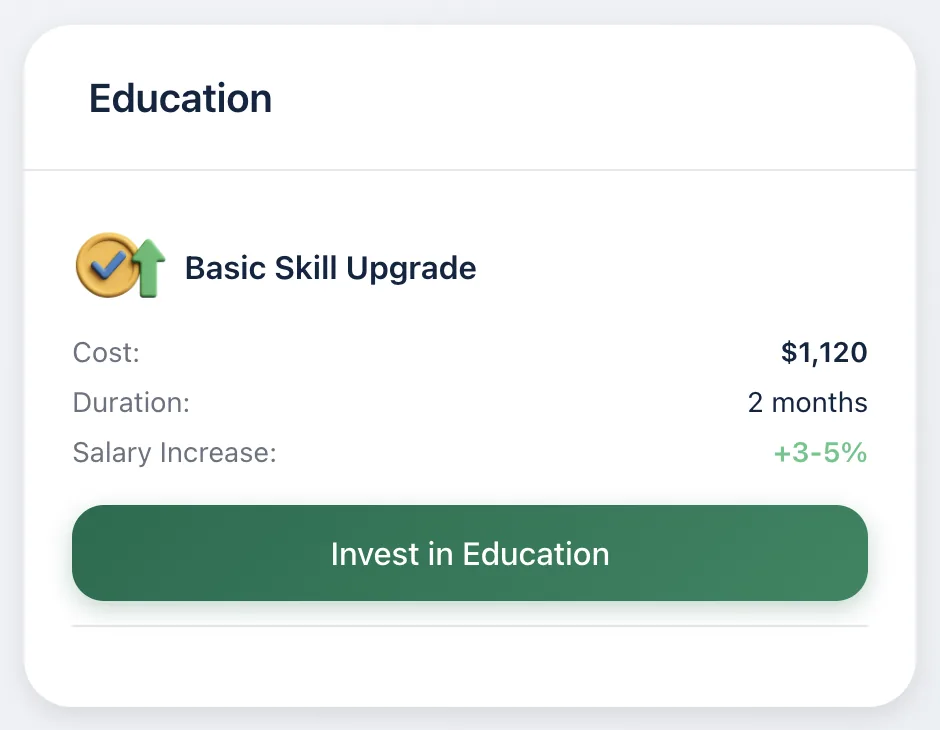
That leaves $840. The Education card offers a Basic Skill Upgrade: $1,120, two months of study, and a permanent raise. The game marks it "Insufficient funds. Try reducing your expenses." So the student makes a call: drop Rent to a Basic Room ($588) and Entertainment to Minimal Leisure ($98). Bills fall to $1,666, the surplus grows to $1,134, and the course becomes affordable, at a cost of 10 health and 10 happiness, from 80 down to 70 each.
Enroll, pay the bills, and Month 1 ends with $14 in cash. No buffer at all: a thin position to carry into a game where a repair bill can arrive at any time.
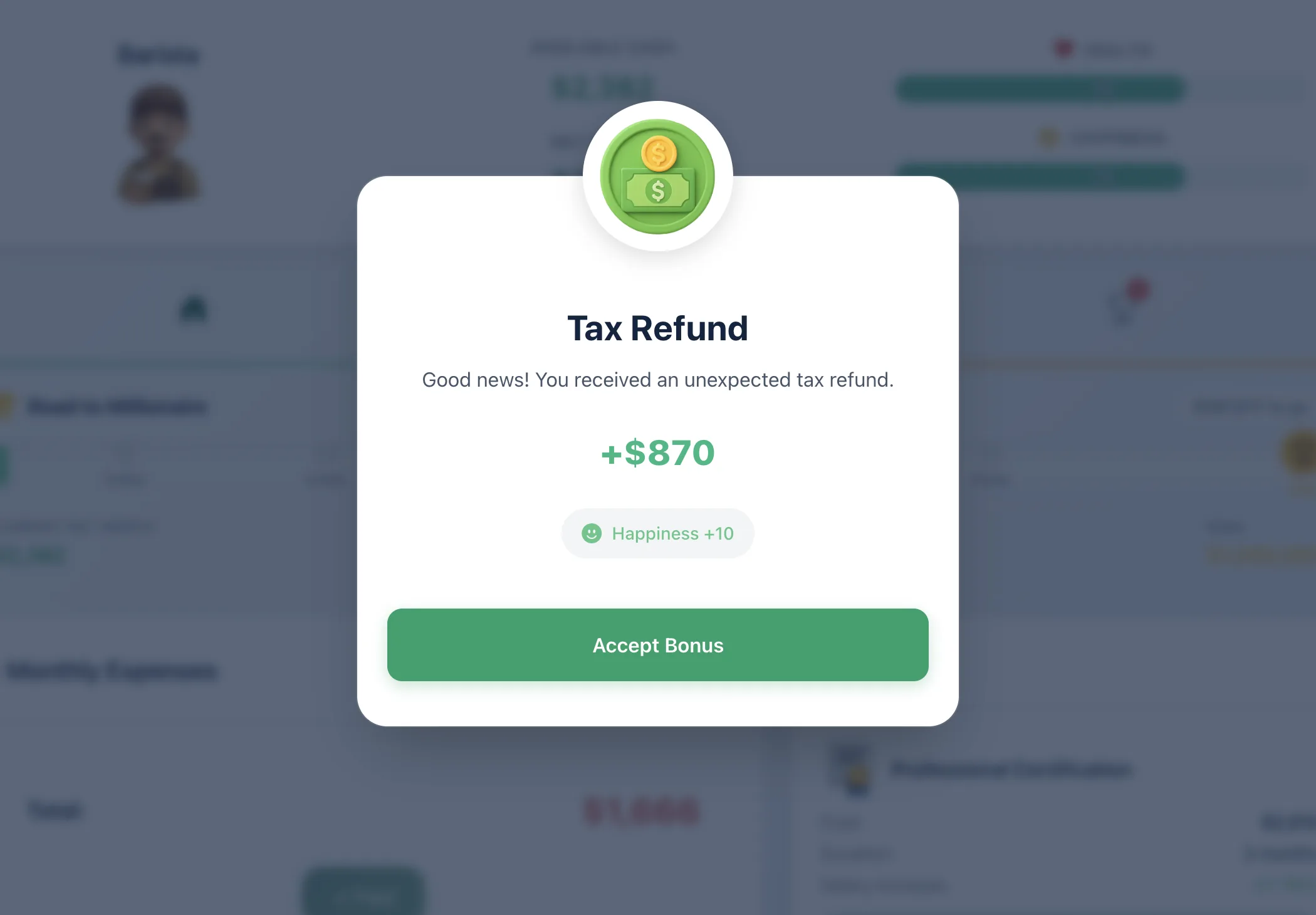
Month 2 brings the next $2,800 paycheck. After the same $1,666 in bills, cash is $1,148. In Month 3 the course completes and the salary rises to $2,900, permanently: every paycheck from here on is bigger because of a decision made in Month 1. Then the first life event lands, a Tax Refund worth $870 and a 10-point happiness boost.
Not every event is this kind. For this Barista, a Car Trouble or Medical Emergency bill can run from a few hundred dollars to more than a thousand, and either has to be paid from cash, savings, or by selling index fund shares before the month can advance.
None of this is graded. The student simply sees what their choices did: a raise that compounds for the rest of the game, two stats that took a hit, and a cash balance that is recovering. Then they decide what to do with the refund.
Play the same three months as a Software Developer earning $7,000 and every number changes, but the decisions don't. That is the point: the student practices the financial decision, not just the arithmetic.
Used as a money management game for students, Ricco puts each concept below in front of the student as a decision they make, usually many times, rather than a term to memorize.
Quizzes, worksheets, and calculators all have a place. They tend to practice a different skill than deciding.
Curious what the research says about learning money skills through games? Our article on whether financial literacy games actually work looks at the evidence, including where it is strong and where it isn't.
As a financial literacy game for high school students, Ricco fits personal finance, economics, business, and life-skills classes where the goal is to make money decisions, not just define them. Students should be comfortable with dollar amounts and basic percentages.
A rehearsal for the first real paycheck: what rent, food, and transportation actually leave over, and what a savings account, a bond, and an index fund each do with it.
No class required. Anyone can create a free account, pick a profession, and start deciding. Progress saves after every month, so short sessions add up.
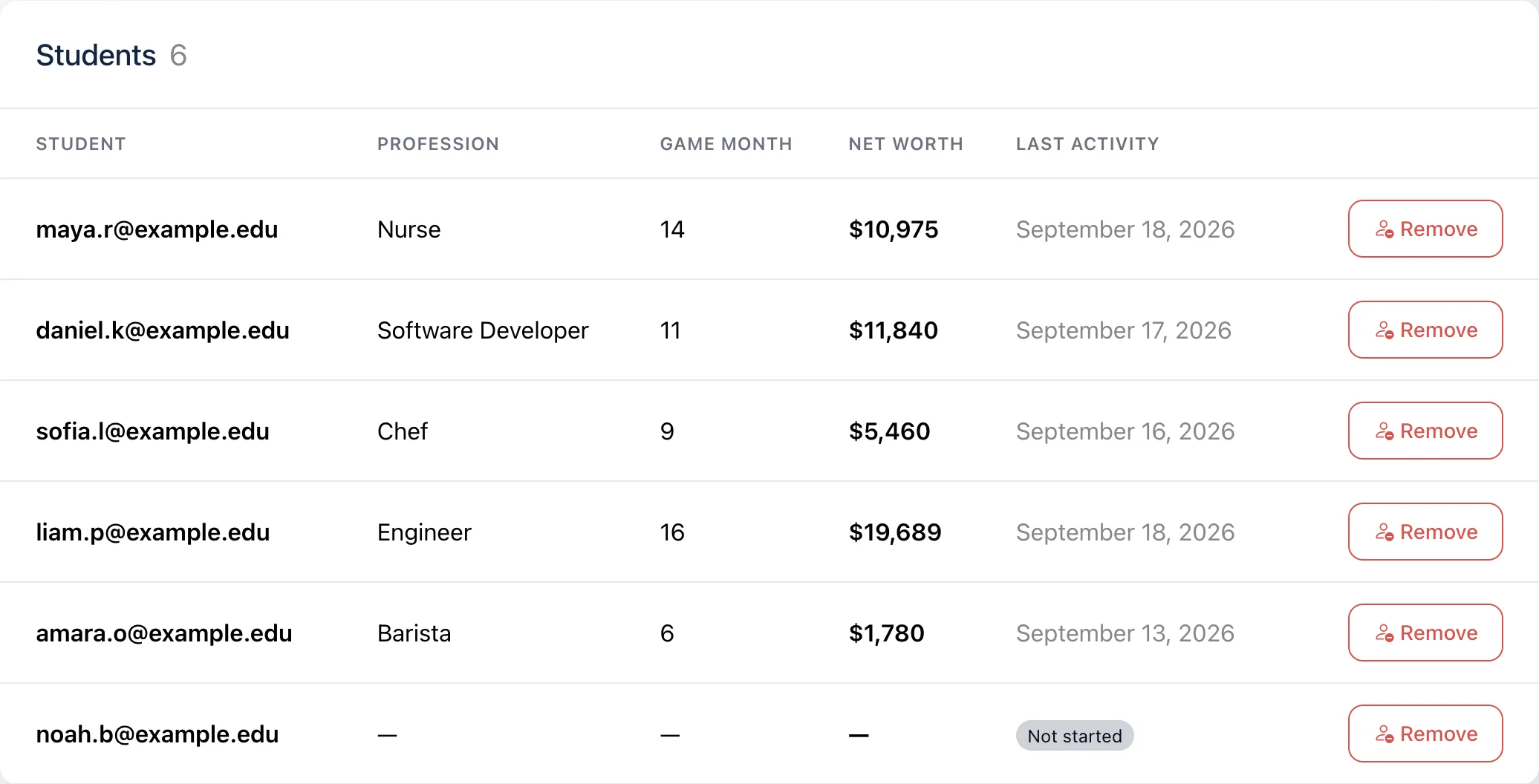
Teachers create a free teacher account, try the game themselves, and when it fits their lessons, purchase a 12-month license that gives every student in their classes full game access through one invitation link. The teacher dashboard shows who has joined, who has started, and each student's profession, game month, net worth, and last activity.
Because every student holds a different profession and faces different events, the same lesson produces different outcomes to compare and discuss.
See Ricco for TeachersYes. Creating an account and playing is free, with nothing to install. The two highest of the four education levels require full access, and from Year 3 of a playthrough so does buying new bonds or index fund shares. Full access comes from an optional one-time Premium upgrade or from a teacher's class license. Savings, existing investments, and everything else keep working.
Ricco is built around adult financial situations: a salary, rent, utilities, repair bills, and long-term investing. Among financial literacy games for high school students it sits at the realistic end, and it is also used by college students and adults. Students should be comfortable reading short scenarios and working with dollar amounts and basic percentages. There is no grade-specific version.
There is no fixed length. Each turn is one in-game month and takes a few minutes: review the numbers, adjust spending, pay the bills, resolve any event, and advance. Progress saves automatically, so a student can play for ten minutes at the end of class or an hour at home and pick up exactly where they stopped.
Students practice earning and raising income, budgeting across five expense categories, saving, investing in bonds and an index fund, paying for education, balancing spending against health and happiness, and responding to unexpected events. Ricco does not simulate credit cards, loans, credit scores, taxes, or insurance.
No. Every dollar in the game is simulated; mistakes cost in-game cash, health, or happiness, never real money. Ricco runs in a web browser on laptops, tablets, and phones, and a student needs only an email address and password to create an account.
Yes. Starting a new game ends the current one and begins fresh with a new profession choice, so a student who played cautiously can try investing early, or the other way around, and compare where each approach leads.
Teachers create a free account, try the game, and purchase a 12-month teacher license when they are ready to bring students in. Each class gets one invitation link; students who join get full game access while the license is active, and the teacher dashboard shows each student's profession, game month, net worth, and last activity. Details are on our For Teachers page.
Pick a profession, collect a paycheck, and find out what your decisions add up to. Free to play, right in your browser, with no real money on the line.