Ricco is a free online investing game with a twist: your portfolio lives inside a whole financial life. A monthly paycheck, five bills, and the occasional nasty surprise decide how much you can invest - and how much you can afford to leave invested.
Open a typical investment game and you're handed a pile of virtual cash with one job: grow it. That's a fun scoreboard, but it skips the part of investing that trips most people up in real life - the money you invest has to come from somewhere, and it has to stay invested while rent is due and the car makes a new noise.
In Ricco, every dollar in your portfolio is a dollar your character earned and didn't spend. The paycheck arrives, the bills get paid, and only then do you decide what the surplus should do - a decision our money management game page explores from three different angles. Here's the path each dollar travels, using a Nurse's real opening numbers from the game.
A Nurse's monthly salary lands as cash. Every dollar you will ever invest starts here.
Rent, groceries, utilities, transportation, and entertainment come due at the lifestyle level you chose - here, Basic Comfort. What's left is your surplus: $1,350.
Part of the surplus stays within reach as cash and savings, because the next surprise bill won't wait for a convenient month.
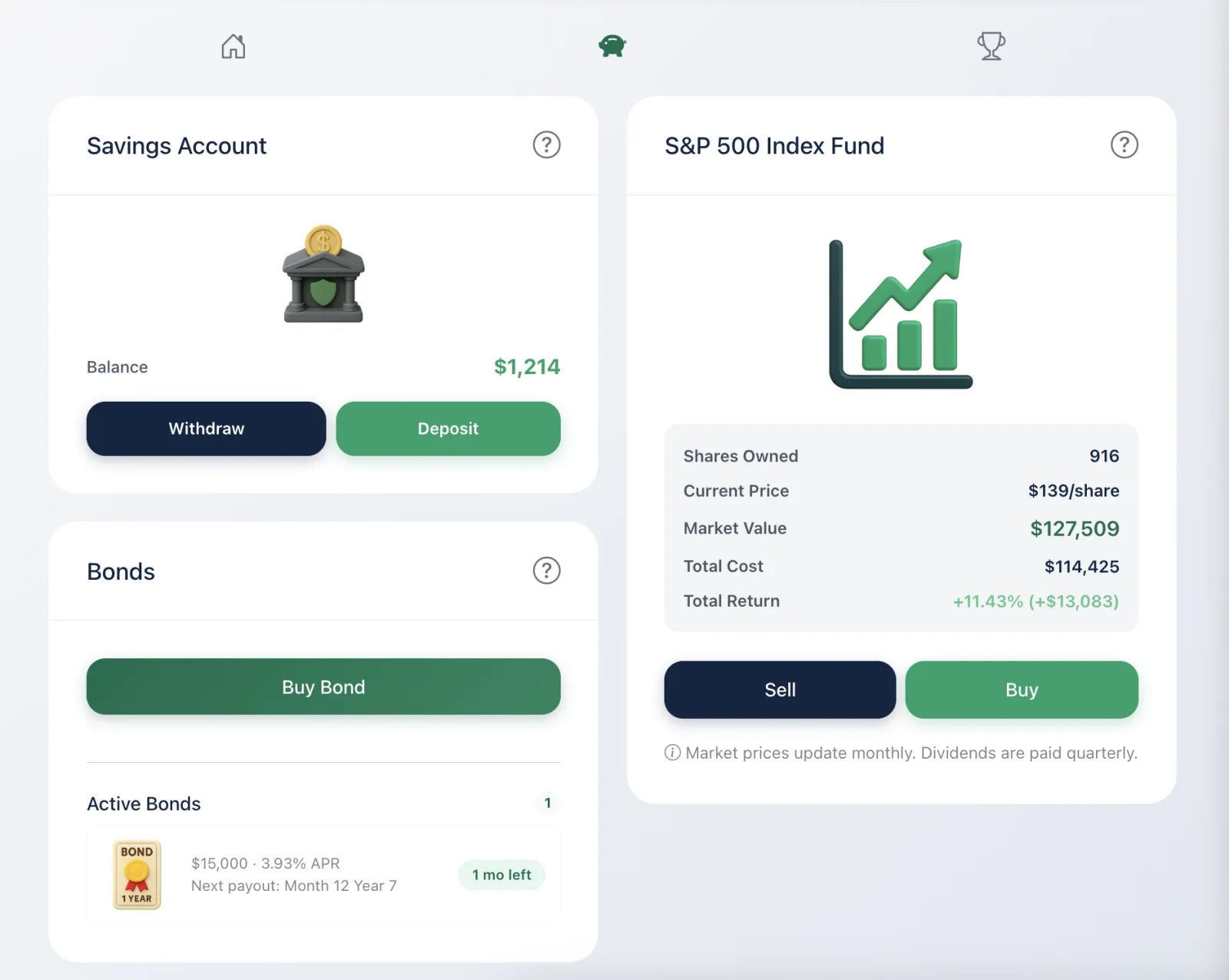
Whatever the buffer doesn't need goes to work: bonds with fixed terms, or index fund shares that compound through market swings.
Cash, savings, bonds, and index fund shares all count toward one number. Grow it to $1,000,000 - without wrecking your health or happiness - and the run is won.
No tickers to research, no thousands of funds to screen. Ricco keeps the menu short so the decisions - how much, where, and when - stay the whole game.
Liquid, steady, always there.
Deposit and withdraw whenever you like. Interest lands once each in-game year, and the rate changes from year to year. It will never make you rich - its job is to be there when a bill demands it.
Fixed terms, fixed rates, no surprises.
Lock a lump sum away at a fixed rate - longer terms pay better rates - and collect interest every in-game year until the principal comes back at maturity. Predictable by design.
The growth engine - with mood swings.
Buy shares with any amount, sell any time. It offers the strongest long-term growth in the game and pays quarterly dividends straight into your cash - but bull and bear markets swing the share price, and a downturn can drag on for months.
There's a fourth way to invest in Ricco, and it isn't a financial asset at all: education. In-game courses cost a large chunk of cash up front and permanently raise your salary when completed - which raises every surplus you'll ever invest afterward. Our personal finance game page walks through that exact decision with real numbers from a playthrough.
Sooner or later, every investing strategy in Ricco runs through the same gauntlet.
The bills are paid and spare cash is sitting idle, so you push it into bonds and index fund shares. Compounding starts - and your buffer gets thinner.
A bear market sets in and the fund's share price falls month after month. On paper, waiting it out is easy. On paper.
A medical emergency or car repair lands out of nowhere - and the game will not advance until it's paid.
Pay from cash? Pull from savings? Sell shares while the price is down? Every answer costs something different.
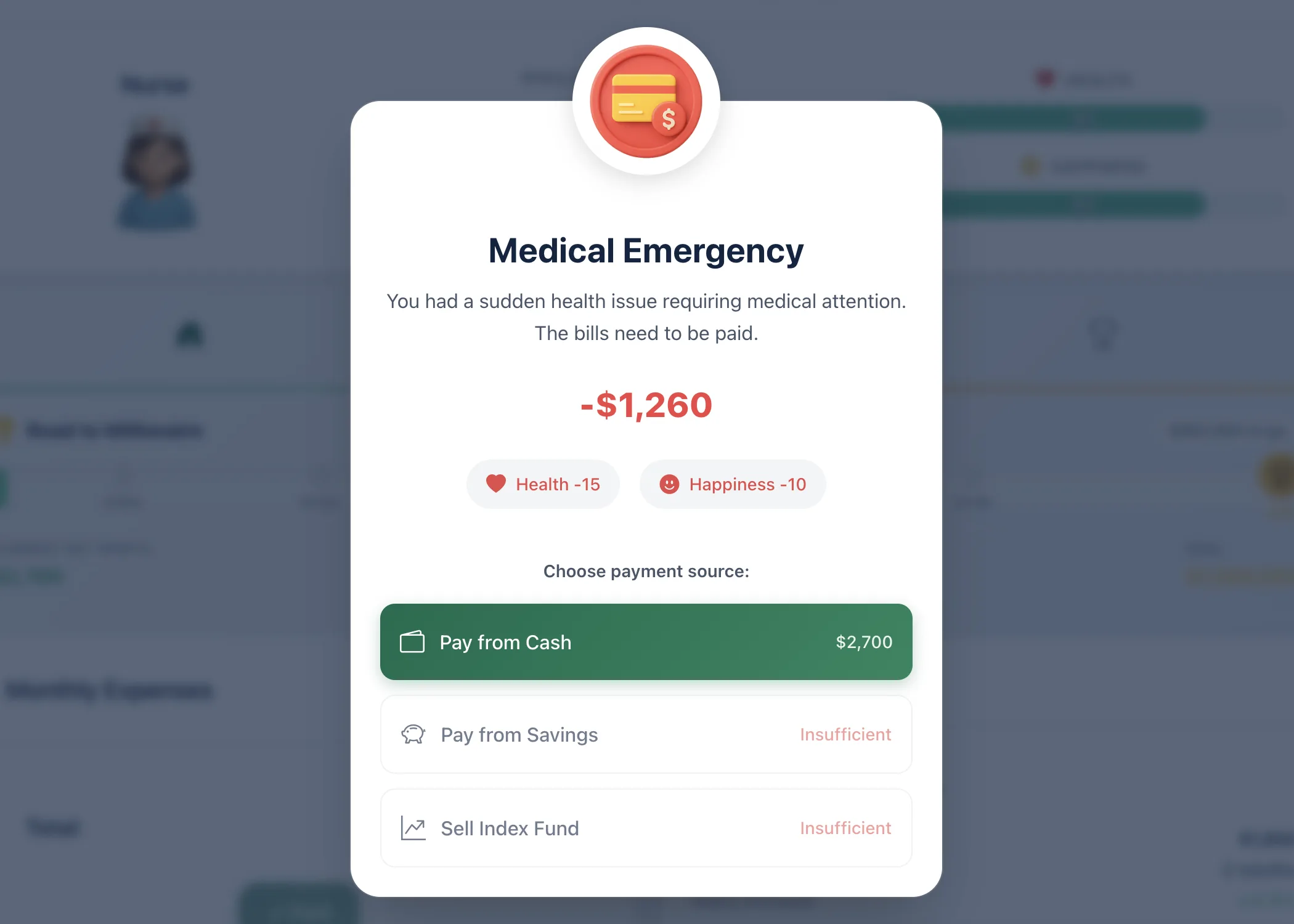
Here's that moment from a real playthrough. A Medical Emergency lands with a $1,260 bill, a hit to health and happiness - and a choice of where the money comes from: cash, savings, or selling index fund shares.
In this run, the savings account and the index fund can't cover the bill on their own - cash is the only door that opens. That's the lesson no portfolio-only investment game can teach: returns are only half of investing. The other half is making sure a surprise never forces you to sell the wrong thing at the wrong time.
Play it differently next run. Keep a fatter buffer and the same event is a shrug. Go all-in on the fund and the same event might mean selling shares into a falling market. The game doesn't grade you - it just shows you what each posture feels like.
Each concept below shows up as a decision you make in the game - usually more than once.
Savings never lose a dollar. Bonds pay a fixed rate for locking money up. The index fund grows fastest and falls hardest. Choosing your mix means feeling that trade-off, not memorizing it.
Cash spends instantly, savings can be withdrawn anytime, bonds are locked until maturity. When the surprise bill lands, liquidity decides whether it's an annoyance or a fire sale.
Quarterly dividends arrive as cash you can reinvest, bond interest lands every year, and a salary raise from education pays into every future paycheck. Growth feeding growth, visibly.
Spread the surplus across savings, bonds, and the fund and no single bad month hits everything at once. Concentrate it and you'll find out why that's the classic mistake.
Bear markets in the game can last for months, and watching your fund shrink builds real pressure to sell. Practicing that patience with play money is the point of a long-term investing game.
Every dollar spent on a nicer lifestyle is a dollar that never compounds - and every dollar invested is a dollar your buffer doesn't have. The game makes you pick, every single month.
Stock market simulators are a great way to learn how markets work. Ricco practices a different skill: fitting investing into a financial life.
If "bonds versus index funds" is still an abstract sentence, buy one of each with play money and watch what they actually do - the interest payment, the dividend, the price swing.
Your real money sits in savings because markets feel like a casino. Rehearse the move from saved to invested here first - including your first simulated bear market - where a mistake costs nothing.
You've read the books and know the vocabulary. What's missing is repetitions: dozens of buy, hold, and sell decisions with consequences that arrive within a session instead of a decade.
An investing game is a simulation where you practice putting money to work - choosing investments, watching them grow or fall, and deciding how to react - without risking real dollars. In Ricco, the investing happens inside a full financial life: a monthly paycheck funds your bills first, and whatever survives is what you can invest.
No. Ricco doesn't use live market data, and there is no stock picking or day trading. It's a turn-based investing game: each turn is one in-game month, and your simulated portfolio - a savings account, bonds, and an S&P 500-style index fund - grows or shrinks alongside the rest of your financial life, bills and surprise expenses included.
Three places: an interest-earning savings account you can tap anytime, bonds that lock money away for 1, 5, or 10 years and pay interest every year, and an S&P 500-style index fund that pays quarterly dividends and moves through bull and bear markets. Separately, you can invest in education, which costs cash up front and permanently raises your character's salary.
Yes. You can create an account and play the core game for free. There is an optional one-time Premium upgrade ($9.99) that unlocks advanced features, such as the higher education levels and continued investing from Year 3 of a playthrough.
Yes - that's the whole idea. Every dollar in Ricco is simulated: the paycheck, the savings account, the bonds, and the index fund shares. Beginners can practice investing decisions and sit through a simulated downturn without risking real money. There are no real securities, no live market data, and no brokerage account involved.
No. Ricco is an investing game for beginners. You start with nothing invested, there are only three assets to learn, and the investing screen keeps the numbers in front of you: balances, interest rates, share prices, and your total return. The consequences teach the vocabulary faster than definitions would.
A game can't replace financial advice, but it compresses time in a way real life can't: years of compounding, multiple market cycles, and a dozen surprise expenses fit into one playthrough. That makes Ricco a long-term investing game in the literal sense - the lesson isn't picking winners, it's staying invested while life keeps happening.
Collect a paycheck, pay the bills, and make your first investment - then see if it survives the year. Free to play in your browser, with zero real money at risk.