Financial Literacy Games for Adults: How to Choose One You Can Play Alone
Compare five financial literacy games for adults you can play alone - by what you actually do, skills practiced, playtime, free limits and price - and pick by goal.

Most lists of financial literacy games for adults are long and treat everything on them as the same kind of thing. A ten-minute credit quiz and a simulation that runs for simulated years are both “games”, but they teach differently, take different amounts of time and suit different goals. Choosing well starts with knowing which type you want.
There are four. Short budgeting challenges drop you into one scenario for one sitting - a month on a low wage, say - and make a point. Interactive lessons teach a concept through quizzes and mini-games, explaining the right answer as you go. Investment games have you evaluate deals and watch a portfolio or financial statement change. Longer financial-life simulations keep the clock running: a salary arrives every month, bills recur, and whatever you do with the surplus compounds over simulated years.
Below is one or two of each type that an adult can play alone, in a browser, without a teacher or a class code. We checked every game’s own site in October 2026 for what you actually do, whether you can play solo, how long it takes and what is free. One disclosure before the table: Ricco is our game, so read that row and section knowing who wrote them.
Quick pick: to feel what a tight month is like, play SPENT. To learn the concepts, start with FDIC’s How Money Smart Are You? For a credit refresher, Money Fit’s Credit Score Simulator. To practice investment decisions, CASHFLOW Classic. To manage money month after month and test strategies, Ricco.
Financial literacy games for adults, compared
| Game | What you actually do | Skills practiced | Solo access and platform | Playtime | Free limits and pricing | Best for |
|---|---|---|---|---|---|---|
| SPENT Urban Ministries of Durham / McKinney | Start with $1,000 and one of three low-wage jobs, then get through 30 days of rent, groceries, transport and surprise bills, choosing which to pay and which to let slide. | Prioritizing bills and making trade-offs on a thin margin | Yes. Browser, no account; a mobile version exists | 10-30 minutes, one sitting | Free, no limits | Feeling what a month with no slack is like |
| How Money Smart Are You? FDIC | Fourteen game-show style games, one per topic: income and expenses, spending and saving plans, savings, credit cards, borrowing, debt, housing, disasters. Each is split into rounds of mini-games and quizzes that earn virtual coins. | Core concepts: budgeting, banking, credit, borrowing, protecting money | Yes. Browser on phone, tablet or computer; account optional (saves progress and certificates). English and Spanish | Varies by game; Your Spending and Saving Plan lists 50 minutes over three rounds | Free, no limits | Learning the rules and vocabulary before making decisions |
| Credit Score Simulator Money Fit by DRS | Start at a simulated score of 600 and make 12 credit decisions - pay on time or late, carry a balance, apply for new cards - with the scoring factor explained after each choice. | Credit habits: payment history, utilization, new credit, account age | Yes. Browser, no account; downloadable summary at the end | Around 10 minutes | Free, no limits | A quick refresher on what moves a credit score |
| CASHFLOW Classic The Rich Dad Company | Web version of the CASHFLOW board game. You're assigned a profession, salary and expenses, move around the Rat Race track and decide which stock, real estate and business deals to buy, sell or pass on, updating a financial statement as you go. You leave the Rat Race when passive income covers your expenses. | Reading a financial statement, assets vs liabilities, cash flow vs capital gains, sizing up deals, using debt | Yes. Browser; free Rich Dad account required (login link by email). Play solo or in an online room with other players | Open-ended. The board game is rated at about 3 hours; a solo web run that stops once you leave the Rat Race is shorter | Web game free with an account. The physical board game is sold separately ($89.95 at the Rich Dad store) | Practicing investment decisions and deal arithmetic |
| Ricco That's us | Pick one of eight professions with a monthly salary, set five recurring expenses at one of four levels, then advance one month at a time: pay bills, handle life events, move the surplus into savings, bonds or an index fund, and pay for education that raises your salary. Goal: $1,000,000 net worth. | Budgeting with recurring bills, keeping a buffer, saving vs investing, raising income, long-term strategy | Yes. Browser on desktop or phone; free account, progress saves | A few minutes per in-game month; one run spans sessions and simulated years | Free: budgeting, saving, life events, the first two education levels, and bond and index fund purchases through Year 2. Premium ($9.99 one-time) for new investments from month 25 and the two advanced education levels | Managing money over time and testing strategies |
We left out financial games for adults that are really built around a student’s life (Money Fit’s Senior Year Sprint, NGPF’s PAYBACK), simulations that only run through a classroom (Budget Challenge), trivia and word games that test recall rather than decisions, and Flash-era titles that no longer load. If what you want is specifically another short challenge in the SPENT mold, we compared those separately in games like SPENT.
Choose by what you want to learn
You want to practice budgeting under pressure
SPENT is the sharpest version of this. You start with $1,000 and one of three low-wage jobs, then make your way through 30 days of rent, groceries, transport and the occasional emergency. Every choice is followed by a short fact about life on low pay, and the game ends when the money or the month runs out. It is free, needs no account and takes 10 to 30 minutes.
Its limit is built in: there is no month two. SPENT shows you what a thin margin feels like. It can’t show you what to do with slack once you have some, because you never do.
You want to learn the concepts first
FDIC’s How Money Smart Are You? is the most complete free option for adults who want to understand the rules before practicing them. It is fourteen separate games, each on one topic - income and expenses, spending and saving plans, savings, credit reports and scores, credit cards, borrowing, managing debt, buying a home, preparing for disasters - played in a game-show format with mini-games and quizzes in each round. It runs on a phone, tablet or computer, in English or Spanish, and an account is optional: you only need one to save progress or earn certificates. Each game lists its own time estimate; Your Spending and Saving Plan is 50 minutes across three rounds.
What it teaches is knowledge rather than decisions. You learn which bills to prioritize, not what it feels like to run short. The FDIC’s own 2025 evaluation found that budget use and regular saving rose among players, with the caveat that the study design can’t prove the games caused it - we go through that evidence in do financial literacy games actually work?
For one topic in less time, Money Fit’s Credit Score Simulator starts you at a simulated score of 600 and walks you through 12 credit decisions, explaining the scoring factor behind each change. It takes around ten minutes, needs no account, and is explicit that the score is a teaching model, not a prediction. Money Fit, a nonprofit credit counseling service, also offers Debt Racer, which runs your own balances through the snowball and avalanche payoff methods side by side. It is more calculator than game, but useful if debt is the problem you are actually trying to solve.
You want to understand investing
CASHFLOW Classic is the web version of Robert Kiyosaki’s board game, free to play with a Rich Dad account (you log in through a link sent by email). You are assigned a profession with a salary and expenses, move around the “Rat Race” track, and decide which stock, real estate and business deals to buy, sell or pass on, keeping a financial statement up to date as you go. You win by leaving the Rat Race: the point at which passive income from your assets covers your monthly expenses. You can play alone or in an online room with other players. The board game is rated at about three hours; a solo web run that stops once you leave the Rat Race is shorter.
It is the best game here for deal arithmetic - cash flow against purchase price, down payments, bank loans, and what a market card does to your position. Two caveats. The game carries a strong point of view (the Rich Dad philosophy on debt and real estate is built into the design), and it treats your budget as a fixed starting condition rather than something you work on. If you want to see how a bond or an index fund behaves inside an ordinary paycheck-to-paycheck budget, that is a different game.
You want to manage money over time
Ricco is a financial-life simulation. You pick one of eight professions with a monthly salary between $2,500 and $8,000, set five recurring expenses - housing, food, transport, utilities, entertainment - at one of four spending levels, and advance one month per turn. Salary in, bills out, and sometimes life interrupts: a car repair, a tax refund, a medical bill. Whatever is left can sit in cash, earn interest in a savings account, buy bonds or index fund shares, or pay for education that raises your salary permanently. Health and happiness move with your choices, so cutting everything to the bone has a cost too. The goal is $1,000,000 in net worth, progress saves, and one run can stretch across sessions and simulated years. Our personal finance game page walks through how each of those pieces feeds the next.
Where Ricco is different, and where it isn’t
The structural difference is time. Because salary and bills recur, a decision in month three keeps charging or paying you in month thirty. Education is the clearest example:
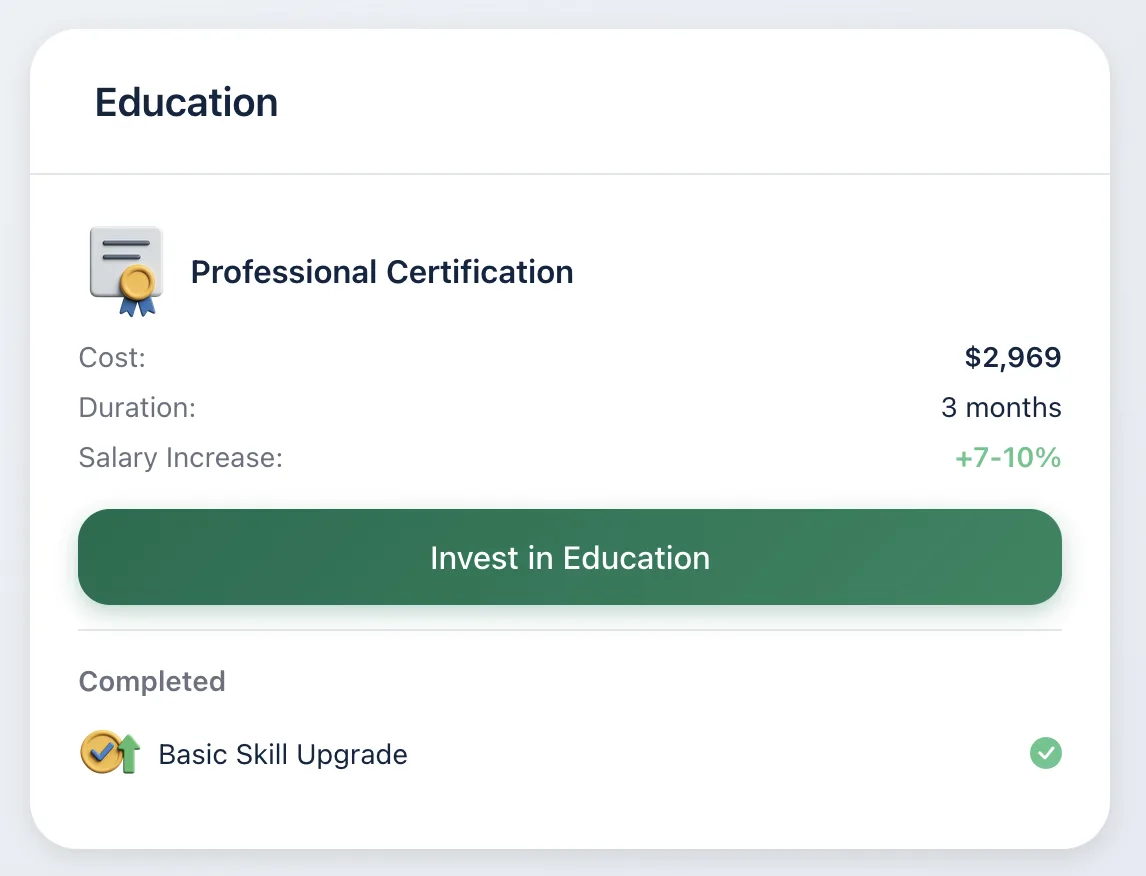
A Professional Certification in Ricco costs $2,969 up front and three months of waiting, in exchange for a permanent 7-10% raise. In a one-month game that is just an expense. Over several simulated years it is a raise that arrives with every paycheck - if you can absorb the hit to your buffer while a repair bill could still land.
That is also an honest statement of what Ricco doesn’t do. It has no credit cards, loans, mortgages, insurance or taxes, so the FDIC games cover more of the rules of money. It doesn’t have SPENT’s punch; the tension builds over months, not minutes. And CASHFLOW Classic goes deeper on individual deals. Ricco’s job is the connective tissue: the same budget, buffer, raise and portfolio, carried forward month after month until you can see whether a strategy holds up. Try Ricco free if you want to see that for yourself.
Why go past the first lesson or the first budget
Financial literacy tends to build in a sequence, and each type of game above covers one or two steps of it. Seeing the whole sequence explains why you might want to move on from the game you started with.
- Understanding money. Terms, rules, how credit and interest work. This is what interactive lessons do well, and the FDIC games are a good place to get it free.
- Managing a budget. Making income cover recurring bills with something left over. SPENT tests this under pressure for one month; Ricco’s free game does it with a salary that keeps arriving, and our budgeting game page walks through one full month of it, bill by bill.
- Building savings. A surplus has to go somewhere. In Ricco, cash is the buffer that turns a $1,260 medical bill into an annoyance; moved to the savings account, it earns interest once a year. A single-sitting game can’t show the difference, because there is no next month for it to matter in.
- Improving earning power. The step most games skip. Education in Ricco costs money and months, then raises every paycheck afterwards. The first two levels are free.
- Investing. CASHFLOW Classic is the place to practice evaluating deals. Ricco’s version is simpler and sits inside the budget: bonds pay fixed interest over one, five or ten years; the index fund moves every month and pays quarterly dividends, so at some point it drops and you decide whether to sell.
- Testing longer-term strategies. Does the most expensive education pay for itself? What happens to an index fund position held through several downturns? Is saving first and investing later better than the reverse? These questions only answer themselves over a simulated decade, and this is where Ricco’s Premium comes in. From month 25, buying new bonds or index fund shares requires it, and the two advanced education levels do at any point. It is a one-time $9.99, not a subscription. Everything else continues free: months keep advancing, bills come due, life events land, and you can still change spending levels, add to savings and sell what you hold.
Two in-game years is enough to learn the budgeting, build a buffer, take the first raise and make your first investing mistakes without paying anything. If the questions in step six don’t interest you, the free game is the whole game.
Frequently asked questions
Are there free financial literacy games for adults?
Yes. Every game in this article has a free version. SPENT, the FDIC games and Money Fit’s Credit Score Simulator are entirely free with no account. CASHFLOW Classic’s web game is free with a Rich Dad account. Ricco is free to play with an account, with an optional one-time Premium upgrade for advanced education and investing beyond Year 2.
Which financial literacy game is best for a complete beginner?
Start with FDIC’s How Money Smart Are You? if you want the vocabulary and rules explained, or with SPENT if you learn better by being thrown in. Either takes less than an hour. Once budgeting feels familiar, a simulation like Ricco lets you practice the same decisions with consequences that carry forward.
Can I play these on my phone?
SPENT has a mobile version, the FDIC games are built for phones and tablets as well as computers, and Money Fit’s simulator and Ricco run in a mobile browser with nothing to install. CASHFLOW Classic is a web game you play after logging in to a Rich Dad account.
Do money management games for adults actually improve your finances?
Research suggests games reliably improve financial knowledge and engagement, while the evidence for lasting behavior change is more mixed. We went through the studies in do financial literacy games actually work? The practical takeaway: treat a game as rehearsal, then turn what you learn into one real-world action - an automatic transfer, a cancelled subscription, a loan compared on total cost.
Sources
- SPENT - playspent.org, Urban Ministries of Durham and McKinney. Loaded in-browser, October 2026.
- How Money Smart Are You? - playmoneysmart.fdic.gov for the account policy and the Your Spending and Saving Plan round times; the FDIC’s Learn Money Smart page for device support, languages and game count. Checked October 2026.
- Credit Score Simulator and Debt Racer - moneyfit.org/games, Money Fit by Debt Reduction Services. Checked October 2026.
- CASHFLOW Classic - richdad.com/cashflow-game-online, the Rich Dad FAQ and registration page for solo web play and email login, the Rich Dad store for the board game price, and BoardGameGeek for the rated playing time. Checked October 2026.
- Ricco - our own game rules; see the FAQ on the personal finance game page.
Ricco is a financial education game. Third-party gameplay, access and pricing details were checked in October 2026 and may change; confirm on each game’s site before relying on them. This article is for educational purposes only and is not financial advice.