Games Like SPENT: What to Play Next
Compare games like SPENT - PAYBACK, Ricco and Budget Challenge - by gameplay, length, solo access, free limits and pricing, and decide what to play next.

SPENT hands you $1,000, one of three low-wage jobs and 30 days to get through. A typical run takes 20 to 30 minutes, and the margins are thin by design. If you’re now searching for games like SPENT, the useful question isn’t which one is best, but which kind you want next.
There are two kinds. Another short challenge drops you into a different scenario for one sitting: new constraints, a point made, done. A longer financial-life simulation keeps the clock running: a salary arrives every month, bills recur, whatever is left over accumulates (or doesn’t), and you find out whether your approach holds up over years rather than weeks. SPENT is the first kind, and very good at it. Whether you want another squeeze or want to start testing what you’d do with some slack decides which list below you should read.
We compared the three alternatives worth your time - one short challenge, one self-paced simulation and one classroom simulation - on what you actually do, how long it lasts, whether you can play alone, what’s free and what costs money. Every game’s own site was checked in September 2026. One disclosure up front: Ricco is our game, so read that section knowing who wrote it.
Quick pick: for another short challenge, play PAYBACK. For a longer simulation you can play on your own, try Ricco. For a classroom, look at Budget Challenge.
Games like SPENT, compared
| Game | What you actually do | Short challenge or longer simulation | Solo access | Free limits | Pricing |
|---|---|---|---|---|---|
| SPENT Urban Ministries of Durham / McKinney | Start with $1,000, pick one of three low-wage jobs and get through 30 days of rent, groceries and surprise bills. Each choice comes with a fact about life on low pay. | Short challenge: one month, roughly 10-30 minutes | Yes, no account needed | Everything is free | Free |
| PAYBACK Next Gen Personal Finance | Enter a GPA, pick a college from your acceptance letters, then make decisions through your degree while the game tracks debt against focus, happiness and connections. | Short challenge: one college run, about 20 minutes | Yes, no account needed | Everything is free | Free |
| Ricco That's us | Choose a profession with a monthly salary, set five recurring expenses, then advance a month at a time: pay bills, handle life events, save, buy bonds or index fund shares and pay for education that raises your salary. | Longer simulation: self-paced, one in-game month per turn, progress saves | Yes, free account | Budgeting, saving and the first two education levels stay free. New bond and index fund purchases need Premium from month 25, and the two advanced education levels always do | Free + optional Premium |
| Budget Challenge ProperLiving | Run an independent young adult's finances in real time for ten weeks: choose vendors, pay bills before their due dates, build an emergency fund, manage a credit card and a 401(k). | Longer simulation: ten weeks of real time, plus about two weeks of onboarding | No, students join with a class code from a teacher | No free student version; teachers can try a free Teacher Play account | Paid classroom access |
We left out trivia-style quiz games, which test recall rather than decisions, and Flash-era titles that no longer run in modern browsers.
SPENT: the baseline
SPENT was built in 2011 by the agency McKinney for Urban Ministries of Durham, a North Carolina nonprofit that serves people experiencing homelessness. You’re a single parent down to your last $1,000. You pick a job, decide how far from work to live, choose which bills to pay and which to let slide, and deal with a sick child or a broken-down car on whatever is left. Each choice is followed by a short fact about poverty, and the game ends when the money runs out or the month does, closing with an invitation to donate.
It’s free, needs no account and has a mobile version. Its strength is focus: one month, one point, no escape hatch. Its limit is the same thing - there is no next month, so there’s nowhere to put what you learned.
PAYBACK: the same format, a different dilemma
PAYBACK comes from the same creative team, this time for the nonprofit Next Gen Personal Finance. You enter a GPA, extracurriculars and home state, choose from the colleges that accept you, then make decisions through your degree - housing, jobs, major, social life - while the game tracks four meters: debt, focus, happiness and connections. Minimizing debt at all costs tanks the other three; ignoring debt buries you at graduation.
It takes about 20 minutes, is free, needs no account and has a Spanish version. It was built for high school students, but the trade-offs are relevant to anyone weighing the cost of a degree. If what you liked about SPENT was the format, this is the closest next play.
Ricco: a financial life that keeps going
Ricco runs in your browser with a free account; an optional one-time Premium upgrade costs $9.99. You pick one of eight professions, each with a monthly salary (artist to doctor), set five recurring expenses - housing, food, transport, utilities and entertainment - at one of four spending levels, and advance one month per turn. Each month the salary lands, the bills come out, and sometimes life interrupts: car trouble, a tax refund, a medical bill, a vacation deal. Health and happiness move with your choices, so cutting every expense to the bone has a cost too. The goal is $1,000,000 in net worth. Progress saves, so one run can stretch across sessions and simulated years.
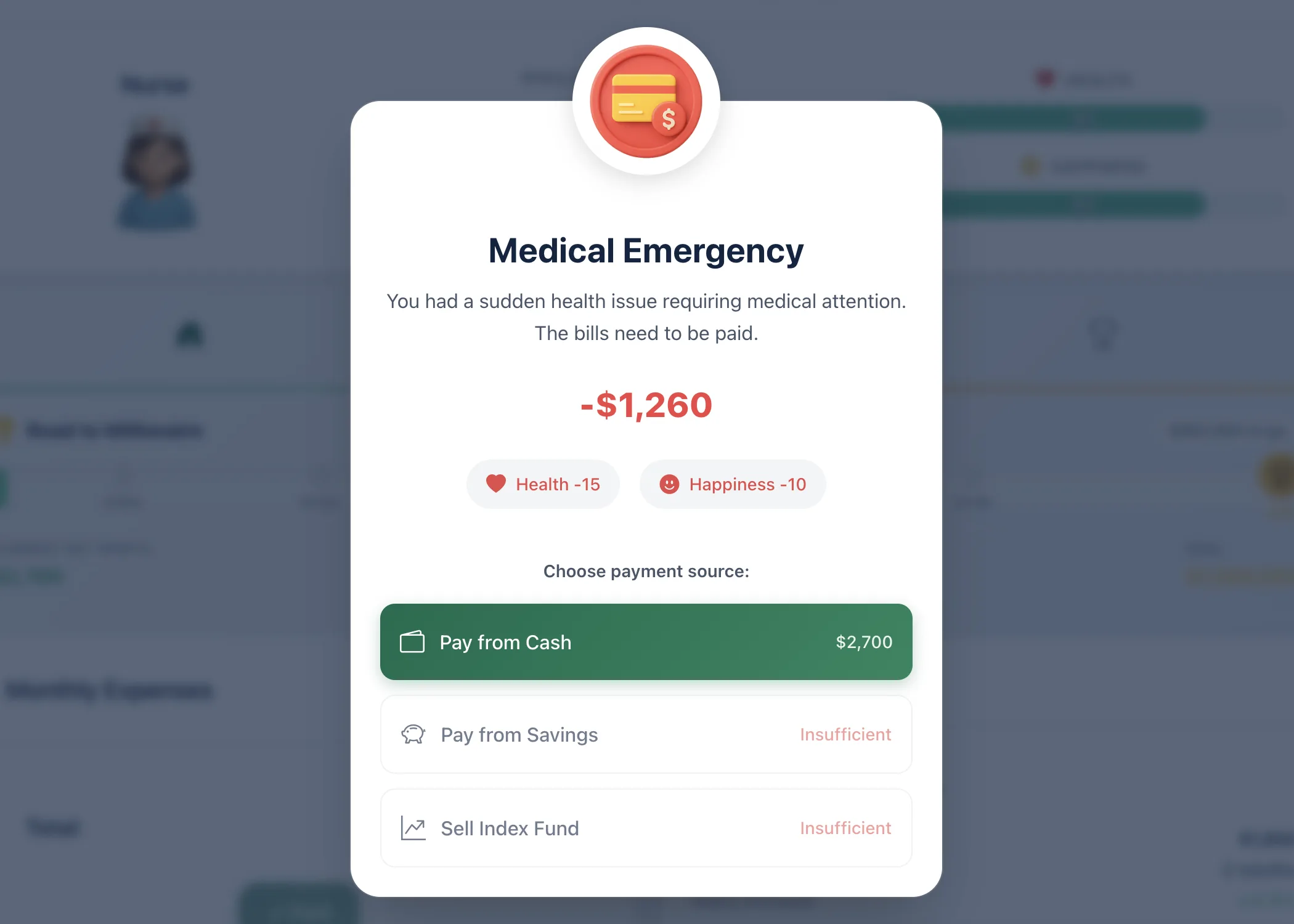
An early surprise in Ricco. The bill is $1,260, it costs health and happiness on top of the money, and the only pocket that can cover it is cash. The same event a year later, with a savings balance and a few index fund shares, is a different decision.
The difference from SPENT is structural rather than a matter of quality. Salary and bills recur, so a choice in month two - upgrading your apartment, say - charges you every month after. Decisions continue: money left over can sit in cash, earn interest in a savings account, buy bonds or index fund shares, or pay for education that raises your salary for the rest of the run. And because the game doesn’t stop at day 30, you can test a strategy - save first, then invest; or invest early and ride out the dips - and see where it lands after several simulated years. Our financial simulation game page shows how those pieces react to each other.
What you give up is SPENT’s punch. Ricco’s tension builds over months rather than minutes. If you want a short, sharp experience, SPENT or PAYBACK is the better pick.
Budget Challenge: a term-long simulation, only through a class
Budget Challenge is a ten-week, real-time simulation used in high school personal finance courses, with about two weeks of onboarding before it starts. Each student runs the finances of an independent young adult: choosing vendors, paying bills before real due dates (late fees included), building an emergency fund, managing a credit card and contributing to a 401(k). An investing module is included with every license, and a companion app lets students pay bills from a phone.
The catch for a solo player is that you can’t simply sign up. Students join with a class code from a teacher, who buys licenses at $30 each, or $24 each with a volume discount that expires at the end of the school year; the company’s state pages advertise school quotes from $20 per student. Teachers can register a free Teacher Play account to try it first. If you teach - or homeschool - and want a term-long simulation with assessment attached, this is the only option here built for that. If you’re playing alone, skip it.
Why keep playing past the first budget
The free version of Ricco covers the natural next step after SPENT - budgeting with a recurring salary - and you could stop there. The reason to continue is that in a longer simulation each skill sets up the next one:
- Budgeting. Set the five spending levels so the salary covers the bills with something to spare, then hold it for a few months. This lets you practise balancing recurring bills over several months. Our budgeting game page walks through one full month, bill by bill.
- Having money left over. A surplus has to go somewhere. Left in cash, it’s the buffer that turns the medical bill above from a crisis into an annoyance. Moved to the savings account, it earns interest once a year.
- Improving earning power. Education costs money and months up front, then raises your salary for the rest of the run. The first two education levels are available without Premium. Unlike a windfall, a raise repeats every month - something a 30-day game can’t show.
- Investing. Bonds pay fixed interest over one, five or ten years. The index fund moves every month and pays quarterly dividends, so at some point you’ll watch it drop and have to decide whether to sell. Both are free for the first two in-game years, and our investing game page explains how they behave.
- Testing longer-term strategies. This is where Premium comes in. From month 25, the start of Year 3, buying new bonds or index fund shares requires Premium; the two advanced education levels require it at any point. Free budgeting doesn’t stop: months keep advancing, bills come due, you can still change spending levels, handle life events, complete the first two education levels, add to the savings account and sell what you already hold.
Two in-game years is enough to learn the budgeting and to make your first investing mistakes for free. Premium is for the questions that only answer themselves over a decade: does the most expensive education pay for itself; what happens to an index fund position held through several downturns; whether saving first and investing later beats the reverse. If those questions don’t interest you, the free game is the whole game.
Which one should you play next?
- You want another 20-minute jolt: PAYBACK. Same format as SPENT, different dilemma, free, no account.
- You want to find out what happens after the month ends: Ricco. Start a free run, budget your way through the first year, and see whether you’re still curious when Year 3 arrives.
- You teach a class or a homeschool group: Budget Challenge, if the budget allows. It’s the only option built for a full term with assessment, and the only one that charges per student.
Frequently asked questions
Is SPENT still available?
Yes. It runs at playspent.org, is free, needs no account, and was rebuilt in HTML5 in 2014, so it works without Flash. It loaded through to the job-selection screen when we checked in September 2026.
Is there a game like SPENT for adults?
SPENT itself is written for adults. PAYBACK and Budget Challenge are built for high school students, though PAYBACK’s trade-offs apply to anyone weighing the cost of college. Ricco is built around adult situations - rent, salary, car repairs, investing - and is the one on this list designed for adults first.
Which games like SPENT work in a classroom?
All four, in different ways. SPENT and PAYBACK need no accounts, so they fit inside a single lesson. Budget Challenge is a full term with teacher dashboards and per-student licenses. Ricco’s free game works for a lesson or two, and a teacher license gives a whole class full access for a year.
Sources
- SPENT - playspent.org, Urban Ministries of Durham and McKinney. Loaded in-browser, September 2026.
- PAYBACK - timeforpayback.com and the NGPF Arcade, Next Gen Personal Finance. Duration from NGPF’s Teacher Tip: INTERACTIVE: Payback.
- Budget Challenge - budgetchallenge.com and its blog for licensing, pricing and the 2026-27 program; state standards pages for the “from $20 per student” quote.
- Ricco - our own game rules; see the FAQ on the budgeting game page.
Ricco is a financial education game. Third-party gameplay, access and pricing details were checked in September 2026 and may change; confirm on each game’s site before buying. This article is for educational purposes only and is not financial advice.