Games Like CASHFLOW: Online Alternatives for Practicing Money Decisions
Compare games like CASHFLOW - Moneyflow, Escape the Grind and Ricco - by gameplay, investing mechanics, solo access, free limits and price, and choose by goal.

CASHFLOW hands you a profession, a salary and a column of expenses, then asks one question for the rest of the game: can you buy enough income-producing assets that their cash flow covers those expenses? Every deal card is a small exercise in that arithmetic - price, down payment, monthly cash flow - and the moment passive income passes expenses you leave the Rat Race. It makes financial independence a number you can see on a sheet of paper, which is why people keep coming back to it.
If you’re looking for games like CASHFLOW, it helps to know that the alternatives split into three kinds. Investment-focused games keep the CASHFLOW loop: a fixed budget, a stream of deals and a passive-income finish line. Financial-life simulations widen the frame so the budget itself is something you work on - earning, spending, saving and raising your income before and while you invest. Traditional board-game experiences are the physical game and its digital stand-ins, with dice, cards and other players at the table.
Below is one or two of each, checked against each game’s own site or store listing in October 2026 for what you actually do, how investing works, whether you can play alone in a browser, what’s free and what costs money. One disclosure before the table: Ricco is our game, so read that row and section knowing who wrote them.
Quick pick: to play CASHFLOW itself, free, use CASHFLOW Classic. For the board-game format against AI opponents on a phone, try Moneyflow. For the passive-income race in a browser with no account, play Escape the Grind. To practice the whole sequence - budget, buffer, raise, portfolio - over simulated years, try Ricco.
Games like CASHFLOW, compared
| Game | What you actually do | Investing and asset ownership | Solo and browser access | Free limits | Pricing |
|---|---|---|---|---|---|
| CASHFLOW Classic The Rich Dad Company | Web version of the board game. You're dealt a profession with a fixed salary and expenses, roll around the Rat Race, and buy, sell or pass on the deal cards you land on while a financial statement updates. Leave the Rat Race when passive income covers expenses, then chase your dream on the Fast Track. | Stocks, funds and CDs, rental real estate and small businesses, each with a price, a down payment and a monthly cash flow. Bank loans allowed, at 10% of the loan as a new monthly expense. | Yes. Browser, free Rich Dad account (login link by email). Create a room for one player, or up to six people and bots | The whole web game is free | Free (web); board game $89.95 |
| Moneyflow Hahnsang Kim (independent) | A CASHFLOW-style board game on a phone: 12 professions, dice, deal and market event cards, three difficulty levels and 45-minute games against AI opponents with different risk appetites, or friends online. | Real estate, stocks, businesses and crypto, with the arithmetic done for you. Win by reaching the Fast Track and your dream. | Solo against AI, yes. iPhone and iPad app only (no browser version; Android listed as coming soon) | Free to download, no in-app purchases listed | Free |
| Escape the Grind SetForMoney | Pick a starting scenario (no debt, mid-career with loans, or paycheck to paycheck) or enter your own numbers, then play one month per turn: pay bills, face life events, resist lifestyle upgrades and invest the margin. Win when passive income covers expenses for three straight months. | 16 asset classes, from high-yield savings and treasury bonds to index funds, dividend stocks, REITs, rental property, side businesses and crypto, each reacting differently to market cycles. | Yes. Browser, no account; nothing is saved, so a refresh starts over | Everything is free | Free |
| Ricco That's us | Choose a profession with a monthly salary, set five recurring expenses at one of four levels, then advance a month at a time: pay bills, handle life events, build savings, invest the surplus and pay for education that raises your salary. Goal: $1,000,000 net worth. | A savings account, bonds of 1, 5 or 10 years, and an S&P 500-style index fund that pays quarterly dividends and moves through bull and bear markets. No property or business deals. | Yes. Browser on desktop or phone, free account, progress saves | Budgeting, saving, life events, the first two education levels, and bond and index fund purchases through Year 2 are free. New investments from month 25 and the two advanced education levels need Premium | Free + optional Premium ($9.99 one-time) |
We left out investing-only games such as NGPF’s STAX, which compresses 20 years of asset allocation into 20 minutes but has no monthly budget or passive-income target and so loses the cash-flow half of CASHFLOW, stock market simulators for the same reason, and the CASHFLOW-branded mobile apps, since the web game is the only digital version Rich Dad’s own site points to. If you want a broader list across budgeting, credit and investing, we compared financial literacy games for adults separately.
CASHFLOW Classic: the reference point
CASHFLOW Classic is the Rich Dad Company’s free web version of the board game. You register for a Rich Dad account, click the login link that arrives by email, and open the game at richdad.com/classic. From there you create a room - for one player, or for up to six people and bots - and the game deals you a profession, a salary and a set of expenses. You choose a dream, and play begins.
Each turn you roll and act on the square you land on: a Small or Big Deal card with a stock, fund, property or business to buy or pass on; a Doodad that drains cash; a Market card that lets you sell; a Downsized or Baby square that changes your statement. The financial statement sits beside the board and updates as you go, and you can borrow from the bank at the cost of 10% of the loan as a new monthly expense. You leave the Rat Race when passive income covers your monthly expenses, then move to the Fast Track to buy your dream.
The physical board game costs $89.95 in the current edition, which updates the professions, cards, board and income statement. It is designed for more than one player - Rich Dad suggests three to six - and rated at about three hours; a solo web run that stops once you leave the Rat Race is shorter.
Two things are worth knowing before you look for alternatives. The budget is a starting condition, not a lever: your salary and expenses change only when a card changes them. And the game carries a point of view - the Rich Dad position on debt, real estate and employment is built into the design. Neither is a flaw, but each explains what the games below do differently.
Moneyflow: the board-game format on a phone
Moneyflow is an independent recreation of the CASHFLOW format as an iPhone and iPad app, built by Hahnsang Kim and not affiliated with Rich Dad. You pick one of 12 professions, roll 3D dice, draw from 67 market event cards, and work toward the Fast Track and your dream. Three difficulty levels change the pressure: Easy halves expenses and lifts returns, Moderate uses 70% of realistic expenses, and Realistic uses full expenses and standard returns. Games are built to finish in about 45 minutes. You can play online with friends or alone against AI opponents - the app names them Aggressive Alex, Balanced Bailey and Conservative Casey - and the calculations are automatic, so the financial statement is something you read rather than fill in.
It is free on the App Store with no in-app purchases listed, and it works offline. The caveats are about maturity: it is a young app with few ratings so far, there is no browser version, and the site lists Android as coming soon. If the part of CASHFLOW you love is the table - dice, cards, opponents - this is the closest thing you can play by yourself.
Escape the Grind: the passive-income race, modernized
Escape the Grind runs in a browser with no account and no setup. You pick a starting scenario - an entry-level job with no debt, a mid-career position with student loans and a car payment eating the margin, or a paycheck-to-paycheck start that is already $240 a month in the red - or enter your own numbers. Each turn is one month. Income arrives, bills go out, and you decide what to do with the gap: pay down debt, put money in one of 16 asset classes (from high-yield savings and treasury bonds to index funds, dividend stocks, REITs, rental property and crypto), or accept a lifestyle upgrade that permanently raises your expenses. Market cycles hit each asset differently, 50-plus life events land, and a stress meter punishes you for declining every temptation. You win when passive income covers expenses for three straight months; run out of cash and you are forced into a payday loan at 180% APR, and a second one ends the game. A typical run takes 30 to 45 minutes.
It was built by Nick Githinji as a showcase for SetForMoney’s budgeting app, and supports 45 currencies with regional versions. Of the games here, it is the closest in spirit to CASHFLOW’s win condition while trading the board for a monthly loop. Its limits are the flip side of its design: nothing is saved, so a refresh starts over; your salary changes only when an event such as a promotion or layoff changes it; and a run is a sprint to the finish line rather than a life you keep living.
Ricco: the same goal, inside a whole financial life
Ricco is a financial-life simulation that starts one step earlier than CASHFLOW. You pick one of eight professions with a monthly salary between $2,500 and $8,000, start with one month’s pay in cash, and set five recurring expenses - housing, food, transport, utilities and entertainment - at one of four spending levels. Then you advance one month per turn. Salary in, bills out, and sometimes life interrupts: a car repair, a tax refund, a medical bill, a vacation deal. Health and happiness move with how you live, so cutting everything to the bone has a cost too. Whatever is left over can sit in cash, earn interest in a savings account, buy bonds or index fund shares, or pay for education that raises your salary for the rest of the run. The goal is $1,000,000 in net worth, progress saves, and one run stretches across sessions and simulated years.
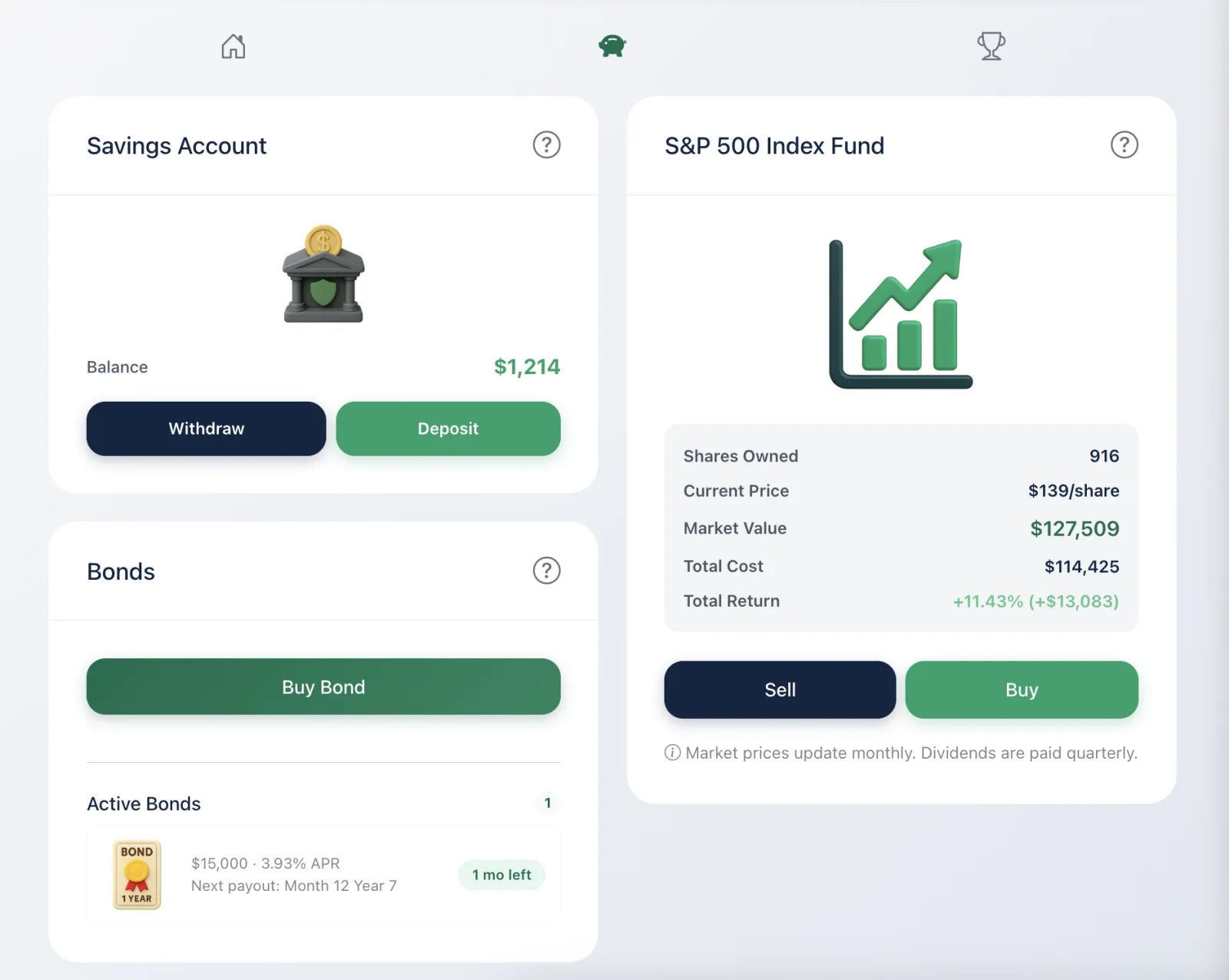
Year 7 of a Ricco run. A $15,000 bond is a month from paying out, and 916 index fund shares bought for $114,425 over several years are now worth $127,509. Each of those dollars was first a month’s surplus, and buying, selling or holding is a fresh decision every month.
Here is the honest comparison. Ricco has no board, dice, deal cards or opponents. There are no property or business deals, no individual stocks, no leverage and no bank loans; the investments are three broad instruments - a savings account that pays 3-5% interest once a year, bonds that lock money for one, five or ten years and pay a fixed rate annually, and an S&P 500-style index fund that moves every month, runs through bull and bear phases and pays a quarterly dividend. If what you want is to evaluate a duplex at a given down payment and cash flow, CASHFLOW Classic does that and Ricco does not.
What Ricco adds is everything around the investing. The budget is the first lever, not a fixed column: upgrading your apartment in month two charges you every month after, and you can reverse it. Income is something you can raise on purpose, through education that costs money and months up front and then lifts every paycheck that follows. And because the game keeps going, your portfolio sits inside a life that keeps billing you - the medical emergency arrives whether or not the index fund is down that month. Our personal finance game page walks through how those pieces feed each other.
Why a CASHFLOW player might want the wider loop
CASHFLOW starts you at the moment you have a budget and the question is what to buy. A longer simulation starts earlier and runs later, and each step sets up the next:
- Earning income. A salary that arrives every month rather than once per lap. In Ricco it ranges from an artist’s $2,500 to a doctor’s $8,000, and the gap between professions shows up in how much slack you have from day one.
- Managing expenses. Five recurring bills you set and can revise. Holding them below the salary for a few months is the free game’s first lesson, and the one CASHFLOW skips.
- Building savings. A surplus needs somewhere to go. In cash it is the buffer that turns a $1,260 medical bill into an annoyance; in the savings account it earns interest at the end of each year. This is where you find out how much buffer you actually want before you invest.
- Investing in assets. Bonds pay a fixed rate on a schedule; the index fund pays dividends and moves with the market, so at some point it drops and you decide whether to sell. Both are free to buy through the first two in-game years, and our investing game page explains how each behaves.
- Generating additional income. The payoff CASHFLOW players are looking for, in a different shape: bond interest, quarterly dividends and savings interest show up in the monthly summary alongside your salary, and an education raise arrives with every paycheck afterwards. The first two education levels are free.
- Testing longer-term strategies. Does the most expensive education pay for itself over a decade? What happens to an index fund position held through several downturns? Is saving first and investing later better than the reverse? These questions only answer themselves over a simulated decade, and this is where Ricco’s Premium comes in. From month 25, the start of Year 3, buying new bonds or index fund shares requires it, and the two advanced education levels do at any point. It is a one-time $9.99, not a subscription. Everything else continues free: months keep advancing, bills come due, life events land, you can still change spending levels, add to savings and sell what you hold, and the bonds and shares you already own keep paying out.
Two in-game years is enough to learn the budget, build a buffer, take the first raise and make your first investing mistakes without paying anything. If the questions in step six don’t interest you, the free game is the whole game.
Which one should you play?
- You want CASHFLOW itself, in a browser, free: CASHFLOW Classic. It is the real game, playable alone, and nothing else here evaluates deals the way it does.
- You want the board, the dice and opponents in 45 minutes: Moneyflow, if you have an iPhone or iPad. Three difficulty levels and AI players make it a good solo practice table.
- You want the passive-income finish line with modern assets and no account: Escape the Grind. Play the hard scenario once and you will understand lifestyle creep in a way a lecture can’t manage.
- You want to practice the steps before and after the deal: Ricco. Start a free run, budget your way through the first year, and see whether the longer questions still interest you when Year 3 arrives.
Frequently asked questions
Is CASHFLOW Classic still free to play online?
Yes. The web game is free with a Rich Dad account. You register with an email address, click the login link that is sent to you, and play at richdad.com/classic - alone in a one-player room or with up to six people and bots. Only the physical board game costs money.
Is there a game like CASHFLOW I can play alone?
All four games here work solo: CASHFLOW Classic in a one-player room, Moneyflow against AI opponents, and Escape the Grind and Ricco by design. Only Moneyflow needs an app rather than a browser.
Does Ricco have real estate or business deals like CASHFLOW?
No. Ricco’s investments are a savings account, bonds and an index fund, plus education that raises your salary. It practices building income from a budget over simulated years rather than evaluating individual deals. If deal analysis is the part of CASHFLOW you want more of, CASHFLOW Classic or Moneyflow is the better pick; if you want to see how a portfolio behaves inside an ordinary paycheck-to-paycheck budget, that is what Ricco is for.
Sources
- CASHFLOW Classic - richdad.com/cashflow-game-online, the Rich Dad FAQ for solo play, email login and bank-loan rules, the registration page, the Rich Dad store for the board game price and current edition, and BoardGameGeek for the rated playing time. Checked October 2026.
- Moneyflow - moneyflow.games and the App Store listing for platforms, pricing, professions, difficulty levels, AI opponents and offline play. Checked October 2026.
- Escape the Grind - setformoney.com/games/escape-the-grind for scenarios, asset classes, win condition, run length, account policy and the developer’s notes. Checked October 2026.
- STAX - buildyourstax.com and the NGPF Arcade, for the “left out” note. Checked October 2026.
- Ricco - our own game rules, as described in the sections above.
Ricco is a financial education game. Third-party gameplay, access and pricing details were checked in October 2026 and may change; confirm on each game’s site before relying on them. This article is for educational purposes only and is not financial advice.