12 Financial Literacy Activities for Adults That Teach by Doing
Try 12 practical financial literacy activities for adults, from budgeting scenarios and paycheck exercises to simulations, saving challenges, and money games.

The best financial literacy activities for adults share one trait: they make you decide something, not just read about it. Every exercise below puts a concrete decision in front of you - allocate this paycheck, cover this surprise bill, pick the cheaper loan - using fictional money, so mistakes cost nothing. Most take under an hour, and each one works either solo or as a group exercise for workshops, classes, or a table of friends.
Here are all 12 at a glance:
| Activity | Time | Skill | Solo or group |
|---|---|---|---|
| 1. One-paycheck budget challenge | 20-30 min | Budgeting | Either |
| 2. Financial-life simulation | 30-60 min | Long-term decision-making | Solo |
| 3. Surprise-expense challenge | 15 min | Emergency planning | Either |
| 4. Decode a sample paycheck | 15-20 min | Earning and taxes | Either |
| 5. Rebuild a budget after an income drop | 20-30 min | Prioritizing under pressure | Either |
| 6. Recurring-cost detective | 30 min | Money management | Solo |
| 7. Compare fictional borrowing offers | 20 min | Borrowing and credit | Either |
| 8. Compound-growth experiment | 20-30 min | Investing | Solo |
| 9. Big-purchase trade-off challenge | 15 min | Opportunity cost | Either |
| 10. Financial-scam spotting | 20 min | Consumer protection | Group |
| 11. Money-scenario debate | 30-45 min | Financial reasoning | Group |
| 12. 30-day money-decision journal | 5 min/day | Awareness and habits | Solo |
1. One-paycheck budget challenge
Time: 20-30 minutes · Skill: budgeting · Solo or group
You get one fictional paycheck and one rule: every dollar gets a job before the month starts.
How to do it:
- Invent a character. Say Sam takes home $3,600 a month, with rent of $1,400, a $180 phone-and-internet bill, and a $260 student loan payment already fixed.
- Allocate the remaining $1,760 across groceries, transportation, savings, and everything else - until the total hits exactly $3,600.
- In a group, give everyone the same paycheck and compare allocations. The arguments over what counts as essential are the actual lesson.
If you’d rather practice with feedback, our budgeting game page shows what a full month of this looks like when the bills actually come due.
2. Financial-life simulation
Time: 30-60 minutes per session · Skill: long-term decision-making · Solo
Budgets are snapshots; a simulation shows the movie. A financial-life simulation compresses years of money decisions into a single sitting, so you can watch a strategy succeed or unravel without waiting a decade.
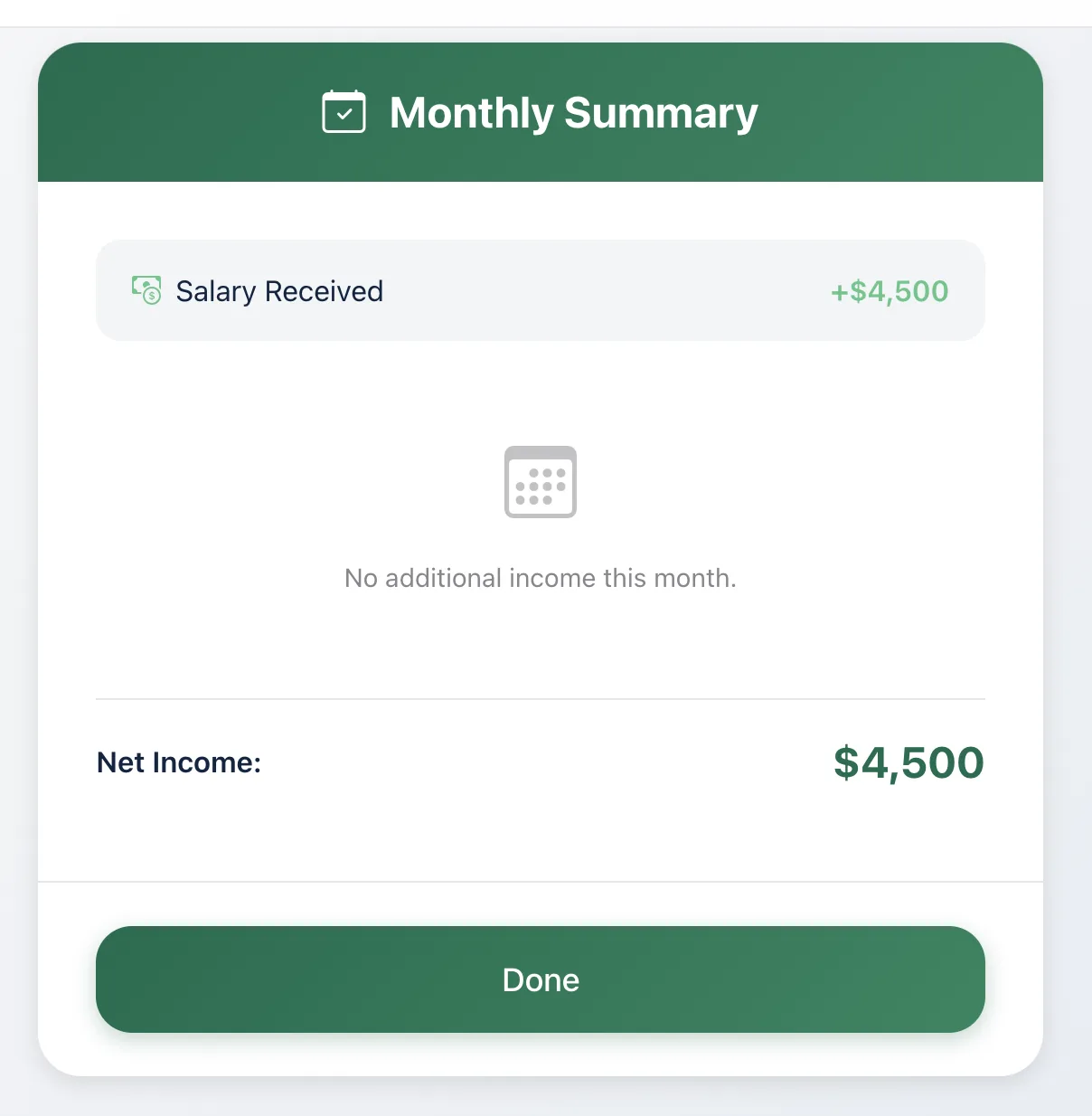
Ricco is a free, browser-based way to run this activity: you get a career, a monthly salary, five recurring bills, and choices about saving, investing, and lifestyle. Each turn advances one month - salary arrives, bills come due, and occasionally life interrupts with a surprise.
How to do it:
- Play one run with a deliberate strategy - for example, build a cash buffer before investing anything.
- Write down where you ended up and what surprised you.
- Start a second run with the opposite strategy and compare. The difference between the two endings is the lesson no article can hand you.
3. Surprise-expense challenge
Time: 15 minutes · Skill: emergency planning · Solo or group
Financial stress rarely comes from the bills you planned for. This drill rehearses the ones you didn’t.
How to do it:
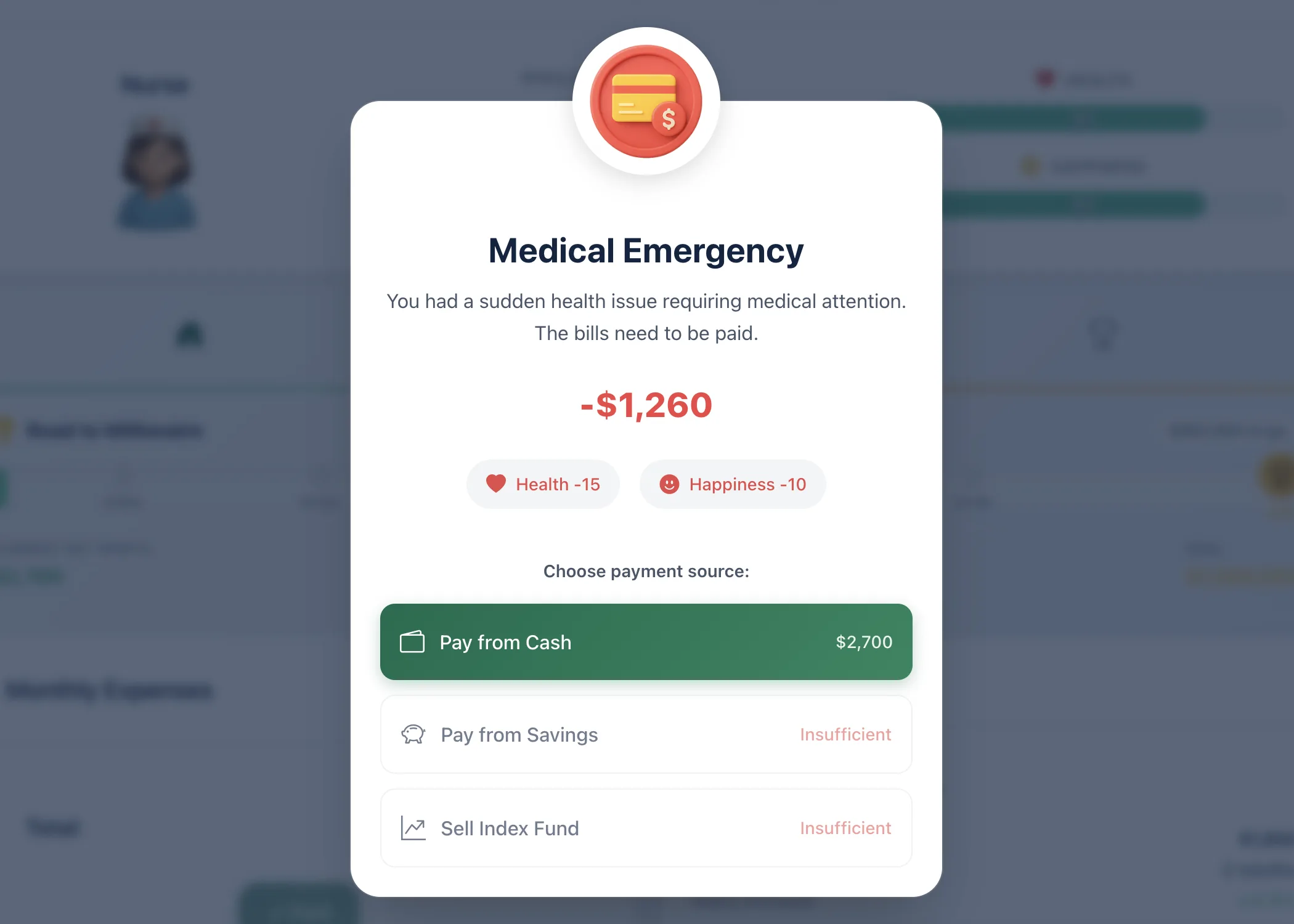
- Write surprise expenses on cards: a $450 car repair, a $900 dental bill, a $1,260 medical emergency, a laptop that dies the week you need it.
- Draw one. Using your budget from activity #1, you have ten minutes to write down exactly how you’d pay it tomorrow - which category shrinks, what gets postponed, what you’d refuse to cut.
- If the honest answer is “a credit card, indefinitely,” that’s not failure - it’s the discovery that an emergency buffer belongs in the budget.
4. Decode a sample paycheck
Time: 15-20 minutes · Skill: earning and taxes · Solo or group
Plenty of adults can name their salary but not their take-home pay, or what happens in between.
How to do it:
- Build a fictional U.S. pay stub: $5,000 gross, minus federal income tax withholding, state or local tax where applicable, Social Security, Medicare, a fictional retirement contribution, and a health-insurance premium.
- Explain every line out loud - to a partner, or to an empty room. Anything you can’t explain in one sentence, look up.
- Then compute the number that actually matters: what percentage of gross pay survives to the bank account, and which deductions you control.
Actual payroll deductions vary by location, employer, and individual circumstances.
5. Rebuild a budget after an income drop
Time: 20-30 minutes · Skill: prioritizing under pressure · Solo or group
Anyone can budget a comfortable month. This activity practices the uncomfortable one - before it happens for real.
How to do it:
- Take Sam’s $3,600 budget from activity #1 and cut the income to $2,700.
- Rebuild it. Notice which costs are contractual (rent, loan payments) and which only feel fixed.
- Write down the order you’d cut things in. That ranked list - made calmly, in advance - is the deliverable.
6. Recurring-cost detective
Time: 30 minutes · Skill: money management · Solo
Among money management activities for adults, this one pays for the time spent most reliably: an audit of everything that charges you on autopilot.
How to do it:
- Pull three months of statements (or use a fictional set in a workshop) and list every recurring charge - subscriptions, memberships, auto-renewals, forgotten free trials.
- Multiply the monthly total by 12. The annual figure is usually the shock.
- Sort the list into keep, cancel, and downgrade, then act on it the same day.
Deciding what your leftover money should do each month is the deeper skill here - the one our money management game page covers in detail.
7. Compare fictional borrowing offers
Time: 20 minutes · Skill: borrowing and credit · Solo or group
Lenders advertise the monthly payment. This exercise trains you to find the total cost instead.
How to do it:
- Invent two offers for the same $10,000 car loan: Offer A at 6.9% APR over 48 months with no fees; Offer B at 5.9% APR over 72 months with a $400 origination fee.
- Run both through any free loan calculator and compare total repaid, not monthly payment.
- Notice the trap: the longer loan feels cheaper every month and costs more in the end. In a group, have half the room defend each offer before revealing the totals.
8. Compound-growth experiment
Time: 20-30 minutes · Skill: investing · Solo
Compounding is easy to nod along to and hard to feel. A spreadsheet fixes that.
How to do it:
- In one column, model saving $200 a month with no growth. In the next, model the same $200 with a steady 6% annual return, compounded monthly.
- Extend both columns to 10, 20, and 30 years and chart them. At ten years, contributions total $24,000, but the growth column sits around $33,000 - and the gap keeps widening.
- Try the rule of 72: divide 72 by an annual growth rate to estimate how many years money takes to double. At 6%, roughly 12 years.
The rates are fictional and real markets don’t move in straight lines - the exercise teaches the shape of the curve, not a forecast. To practice the same curve with decisions attached - simulated dividends, bond interest, and market swings included - our investing game page shows how compounding plays out inside Ricco.
9. Big-purchase trade-off challenge
Time: 15 minutes · Skill: opportunity cost · Solo or group
Every purchase quietly costs whatever else the money could have done. This activity makes that visible before you buy.
How to do it:
- Pick a fictional want: a $1,800 e-bike.
- Write three alternative futures for the same money: what it covers in bills, what it becomes after ten years in the compound-growth spreadsheet from activity #8, and what smaller purchase would deliver most of the same joy.
- Then decide - buying is a legitimate outcome. The point is deciding with the trade-offs on the table instead of discovering them later.
For a fourth column, price the e-bike in your own hours with our price to hours worked calculator: at $20 of take-home pay per hour, $1,800 is 90 hours of paid work. It is a work-hour equivalent rather than a savings timeline, but it makes the trade-off concrete.
10. Financial-scam spotting
Time: 20 minutes · Skill: consumer protection · Group
If you want fun financial literacy activities for adults that work in a workshop, start here - it plays like a quiz and builds a genuinely protective reflex.
How to do it:
- One person writes six short messages: some legitimate (a real bank fraud alert, a delivery notice), some scams (a “guaranteed 30% return” pitch, a fake invoice, an urgent request to pay a fee with gift cards).
- The group sorts them and defends each call.
- Debrief the tells: manufactured urgency, guaranteed returns, unusual payment methods, and links you didn’t ask for. Repeat with new messages until the tells feel obvious.
11. Money-scenario debate
Time: 30-45 minutes · Skill: financial reasoning · Group
Most money questions worth asking don’t have one right answer. Debating them forces you to articulate reasoning you usually leave on autopilot.
How to do it:
- Pick a scenario with real tension: “A fictional couple has $5,000 - pay extra on a 4% car loan or start investing?” or “Should Priya, 28, rent for flexibility or stretch for a mortgage?”
- Assign sides regardless of personal opinion and give each team five minutes to argue.
- Close with what would change your mind - the question that turns opinions into frameworks.
12. 30-day money-decision journal
Time: 5 minutes a day for a month · Skill: awareness and habits · Solo
Not a spending tracker - a decision log. Spending trackers record what happened; this records why.
How to do it:
- Once a day, write one line about a money decision you made: what it was, why you made it, and how it felt.
- Include the invisible ones - the subscription you didn’t cancel and the lunch you didn’t pack are decisions too.
- Review weekly and look for patterns: the times of day, moods, or situations where your money quietly moves without you.
Which activity should you start with?
Match the activity to whatever bothers you most right now:
- Never budgeted seriously? Start with the one-paycheck challenge (#1), then stress-test it with the income drop (#5).
- Money vanishes and you’re not sure where? The recurring-cost detective (#6) and the 30-day journal (#12) will find it.
- A surprise bill would sink you? Run the surprise-expense challenge (#3) until it wouldn’t.
- Want one activity that exercises almost everything? The financial-life simulation (#2) chains budgeting, saving, investing, and surprises into a single loop - our personal finance game page explains how those pieces connect.
- Running a workshop? Scam spotting (#10) and the money debate (#11) are the reliable group personal finance activities for adults - competitive enough that nobody checks their phone.
Why hands-on financial activities can help
The case for practicing rather than just reading is stronger than it might seem. The 2026 TIAA Institute-GFLEC Personal Finance Index found that U.S. adults correctly answered only 47% of its 28 financial literacy questions on average - the lowest result in the survey’s ten-year history - and that low financial literacy tracks with real outcomes like struggling to make ends meet. For a 12-question practice check you can finish in a few minutes, try our financial literacy quiz for adults.
Education moves that needle: a meta-analysis of 76 randomized experiments covering more than 160,000 people, published in the Journal of Financial Economics, found that financial education produces meaningful improvements in both financial knowledge and downstream financial behavior.
Broader research on serious educational games also supports learning by doing. A meta-analysis in the Journal of Educational Psychology found that serious games outperformed conventional instruction on learning and retention, with stronger results when learners played across multiple sessions and worked in groups. For structured worksheets used by practitioners, the CFPB’s free Your Money, Your Goals toolkit pairs well with everything above.
Frequently asked questions
What makes an activity better than reading another personal finance article?
Retrieval and consequence. An article hands you a conclusion; an activity makes you produce one - allocate the paycheck, pick the loan, absorb the surprise bill - and then shows you whether it held up. Decisions you’ve rehearsed are the ones you can actually execute under stress.
Are online financial literacy activities as effective as in-person workshops?
Research on serious games suggests repeated sessions and opportunities to discuss or supplement the experience can improve learning outcomes. Online simulations are useful for immediate feedback, while group activities add discussion and comparison.
How much time do these activities actually take?
Most take 15 to 60 minutes, and the journal takes five minutes a day. What matters more than session length is coming back: research on learning through games found stronger results across multiple sessions than from a single sitting, so a 20-minute activity repeated monthly beats a one-time deep dive.
Do I need real money or my real financial data?
No. Every activity here works with fictional numbers, which is exactly why it’s safe to be honest - and to share in a group without disclosing your finances. Simulations use play money by design, and you can always re-run any exercise later with your own numbers, privately.
Try the activities with a whole financial life attached
The fastest way to string most of these skills together is to practice them inside one continuous scenario: a salary, bills, savings, investments, and surprises that all react to each other. That’s what Ricco simulates, free and in your browser - create an account and see how your strategy holds up over a few simulated years.
Ricco is a financial education game. This article is for educational purposes only and is not financial, investment, or tax advice. All names, paychecks, prices, and rates in the activities are fictional examples, not recommendations.